How Social Interaction can improve your Mental Health

- posted: Apr. 17, 2023
Many persons who have a mental disorder have the thought embedded in their mind that they lack the ability to communicate effectively. Most times this can prevent someone from making and keeping friends, thriving in a work environment, and even maintaining relationships with families.
Social relationships- both quantity and quality- can affect mental health as well as physical health. Sound mental health can easily help a person overcome challenges and problems they encounter in life.
Social Interaction and its Effect on an Individual's Mental Health:
Mental health and social interaction work together to ensure that an individual is capable of functioning and handling their day-to-day life.
1. Social interaction has been shown to reduce stress levels. We know that stress is a disease that deteriorates our mental health. Chronic stress can exaggerate one's mental health condition, making it more difficult for them to cope.
2. Little to no social interaction can prevent someone who has a mental condition from developing meaningful relationships. Most times we find that affected individual tends to isolate themselves if they are depressed or have any other mental illness. But, if a person continues to isolate themselves, this lack of social interaction can lead to more damaging effects on their mental health.
3. It is necessary for individuals with mental illness to have the opportunity to have someone to talk to and create new relationships. This improves their symptoms and gives them a sense of normalcy that they need to feel accepted and function in their environment.
Persons with mental illness often avoid others, are avoided by others, or both, and they may end up isolating themselves altogether. However, the quality of our relationship with others subsequently affects us and it takes a toll on our mental health.
We need to remember that:
- There are benefits to nurturing our social life.
- We all need social support from friends and families in order to heal and cope with our daily struggles.
- A small positive interaction can improve our mood immensely. For example, you were overwhelmed at work, and on your way home you bumped into a stranger who said something kind to you. This automatically makes you forget your troubles for the day and this helps you to see the world in a different light.
Most times we avoid accepting an invitation to an event just to avoid social interaction. And this can be for a number of reasons, from feeling down to wanting to avoid awkward social interaction. But we need to remember, most times when we go out to an event we tend to meet new people, build relationships, and have that feeling of being supported and included.
Here are a few simple tips we can practice to start being more social:
1. Reach out to others in moments when you are in a low mood and want to isolate yourself. We can also obtain help from peer support specialists, a professional who understands mental illness. They can help to boost your social skills and confidence.
2. Join a support group or see a professional counselor.
3. A more daring, yet simple tip is to approach a stranger or an acquaintance as you go through your day. For example, say "hi" to a neighbor as you pass them, or initiate a conversation with someone at a bus stop.
4. Check in on someone you haven't talked to in a while. By reaching out, you are breaking down the wall that might have been preventing that person from reaching out to you. Not only can you feel better, but you also can help someone else feel better, too.
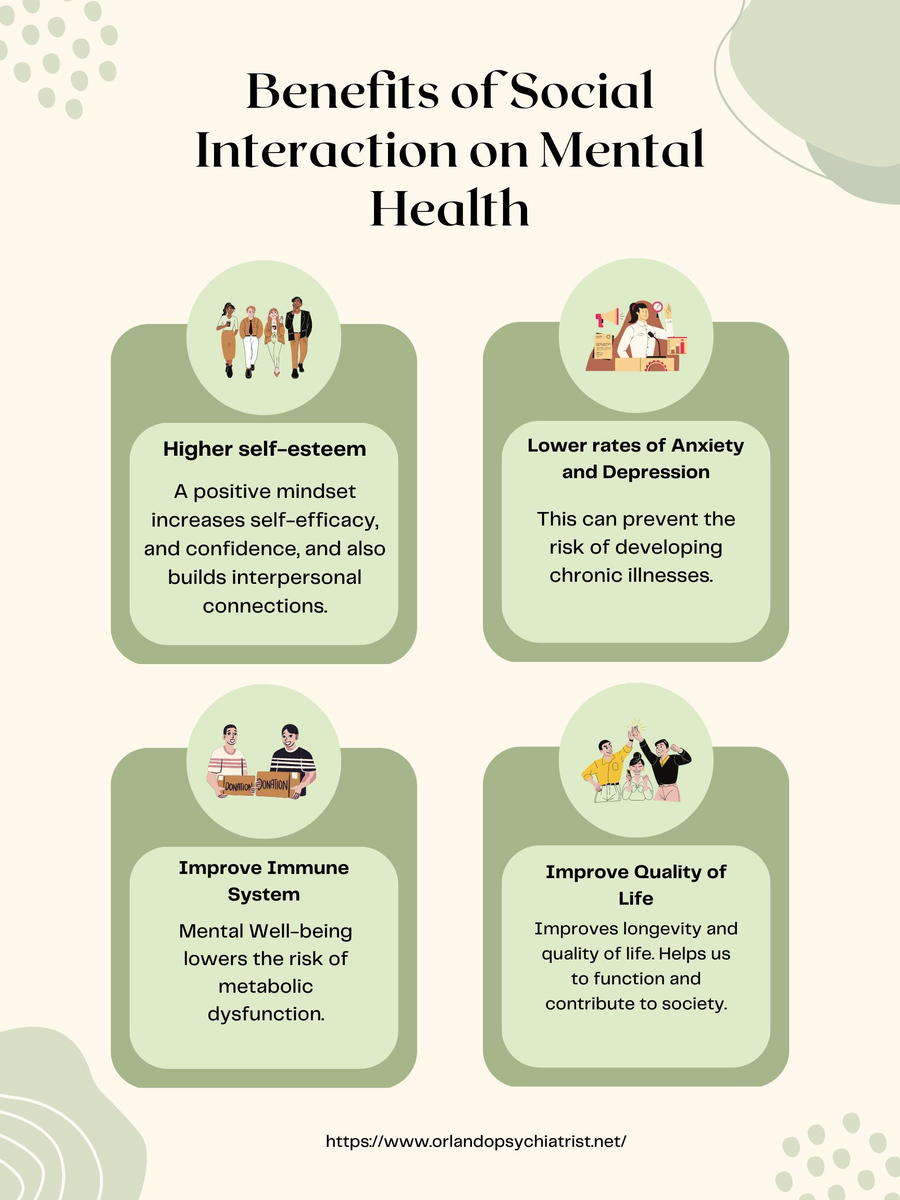
Some health benefits of social interactions include:
- Lower rates of anxiety and depression
- Improve self-esteem
- Greater empathy
- Build more trusting and quality relationships
- Studies show it also helps to improve your immune system
- People around will want to spend more time with you, help you, and support you.
Loneliness has a dramatic effect on your health. It can lead to disrupted sleep patterns, and increase cortisol (stress hormone). It is also a risk factor for depression and suicide.
Kind regards,
Bayhill Psychiatric Associates & Team
Contact Us Today!
Our mental resilience is an evolving system — constantly adapting to our circumstances and how we make use of our abilities. We thank you for your interest in our articles. And thank you for providing positive feedback about Dr. Sultana's services! We are pleased to see you are taking an interest in mental health and helping all of us.
We are located in Orlando, and we accept new patients all across the state of Florida ages 5-70 years old.
We have Telehealth and In-Office appointments available.
Call us today at 407-903-9696.
Book your appointment and get your psychiatric evaluation done at your convenience.
If you know someone that needs evaluation and professional help, kindly refer them to your local Board Certified Psychiatrist for evaluation and treatment.
- posted: Apr. 17, 2023
Many persons who have a mental disorder have the thought embedded in their mind that they lack the ability to communicate effectively. Most times this can prevent someone from making and keeping friends, thriving in a work environment, and even maintaining relationships with families.
Social relationships- both quantity and quality- can affect mental health as well as physical health. Sound mental health can easily help a person overcome challenges and problems they encounter in life.
Social Interaction and its Effect on an Individual's Mental Health:
Mental health and social interaction work together to ensure that an individual is capable of functioning and handling their day-to-day life.
1. Social interaction has been shown to reduce stress levels. We know that stress is a disease that deteriorates our mental health. Chronic stress can exaggerate one's mental health condition, making it more difficult for them to cope.
2. Little to no social interaction can prevent someone who has a mental condition from developing meaningful relationships. Most times we find that affected individual tends to isolate themselves if they are depressed or have any other mental illness. But, if a person continues to isolate themselves, this lack of social interaction can lead to more damaging effects on their mental health.
3. It is necessary for individuals with mental illness to have the opportunity to have someone to talk to and create new relationships. This improves their symptoms and gives them a sense of normalcy that they need to feel accepted and function in their environment.
Persons with mental illness often avoid others, are avoided by others, or both, and they may end up isolating themselves altogether. However, the quality of our relationship with others subsequently affects us and it takes a toll on our mental health.
We need to remember that:
- There are benefits to nurturing our social life.
- We all need social support from friends and families in order to heal and cope with our daily struggles.
- A small positive interaction can improve our mood immensely. For example, you were overwhelmed at work, and on your way home you bumped into a stranger who said something kind to you. This automatically makes you forget your troubles for the day and this helps you to see the world in a different light.
Most times we avoid accepting an invitation to an event just to avoid social interaction. And this can be for a number of reasons, from feeling down to wanting to avoid awkward social interaction. But we need to remember, most times when we go out to an event we tend to meet new people, build relationships, and have that feeling of being supported and included.
Here are a few simple tips we can practice to start being more social:
1. Reach out to others in moments when you are in a low mood and want to isolate yourself. We can also obtain help from peer support specialists, a professional who understands mental illness. They can help to boost your social skills and confidence.
2. Join a support group or see a professional counselor.
3. A more daring, yet simple tip is to approach a stranger or an acquaintance as you go through your day. For example, say "hi" to a neighbor as you pass them, or initiate a conversation with someone at a bus stop.
4. Check in on someone you haven't talked to in a while. By reaching out, you are breaking down the wall that might have been preventing that person from reaching out to you. Not only can you feel better, but you also can help someone else feel better, too.
Some health benefits of social interactions include:
- Lower rates of anxiety and depression
- Improve self-esteem
- Greater empathy
- Build more trusting and quality relationships
- Studies show it also helps to improve your immune system
- People around will want to spend more time with you, help you, and support you.
Loneliness has a dramatic effect on your health. It can lead to disrupted sleep patterns, and increase cortisol (stress hormone). It is also a risk factor for depression and suicide.
Kind regards,
Bayhill Psychiatric Associates & Team
Contact Us Today!
Our mental resilience is an evolving system — constantly adapting to our circumstances and how we make use of our abilities. We thank you for your interest in our articles. And thank you for providing positive feedback about Dr. Sultana's services! We are pleased to see you are taking an interest in mental health and helping all of us.
We are located in Orlando, and we accept new patients all across the state of Florida ages 5-70 years old.
We have Telehealth and In-Office appointments available.
Call us today at 407-903-9696.
Book your appointment and get your psychiatric evaluation done at your convenience.
If you know someone that needs evaluation and professional help, kindly refer them to your local Board Certified Psychiatrist for evaluation and treatment.
Office Hours
Monday
9:00 AM - 5:00 PM
Tuesday
Closed
Wednesday
9:00 AM - 5:00 PM
Thursday
9:00 AM - 5:00 PM
Friday
9:00 AM - 1:00 PM
Saturday
Closed
Sunday
Closed

We greatly value patient feedback and appreciate that online reviews are a useful tool that consumers use to educate themselves and select medical services. However, please be aware, unlike other businesses who may respond freely to online reviews, as medical professionals, we must, and do, provide complete confidentiality to our patients. That means we are prohibited from responding in any way that acknowledges whether someone has been in our care. If you have an issue that needs attention, please contact our office directly.
If you are having a psychiatric emergency, please dial 988 or contact the National Suicide Prevention Lifeline Crisis Text Line by texting HOME to 741741, or go to the nearest Behavioral hospital. If you are having a medical emergency please call 911 or go to the nearest emergency room.